If you've ever stood in front of a closet, a drawer, or a garage full of "maybe someday" and left an hour later having decided on exactly nothing, you already know what decluttering decision paralysis feels like. It's one of the most common things I run into as a professional organizer, and it rarely has anything to do with the item itself. It's about the pressure to make the correct choice, as if there's one right answer waiting to be found if you just think about it long enough.
I recently picked up a framework from an unexpected source — a childbirth education class — that's become one of my favorite tools for breaking that freeze. It's called BRAIN, and it was designed to help people make decisions in the delivery room. It turns out it works just as well on a closet.
What Decision Paralysis Looks Like When You're Decluttering
Decision paralysis shows up in a home the same way it shows up anywhere else: too many options, not enough clarity, and a fear of getting it wrong. Do I get rid of this? Do I need an organizational tool for it? Do I sell it or donate it? Do I store it here or somewhere else? Will I miss it? Will I want it for a rainy day?
Ask enough of those questions without a way to answer them, and most people don't decide. They put the item back "for now." The pile gets a permanent address. Nothing moves — and often, the whole project gets abandoned.
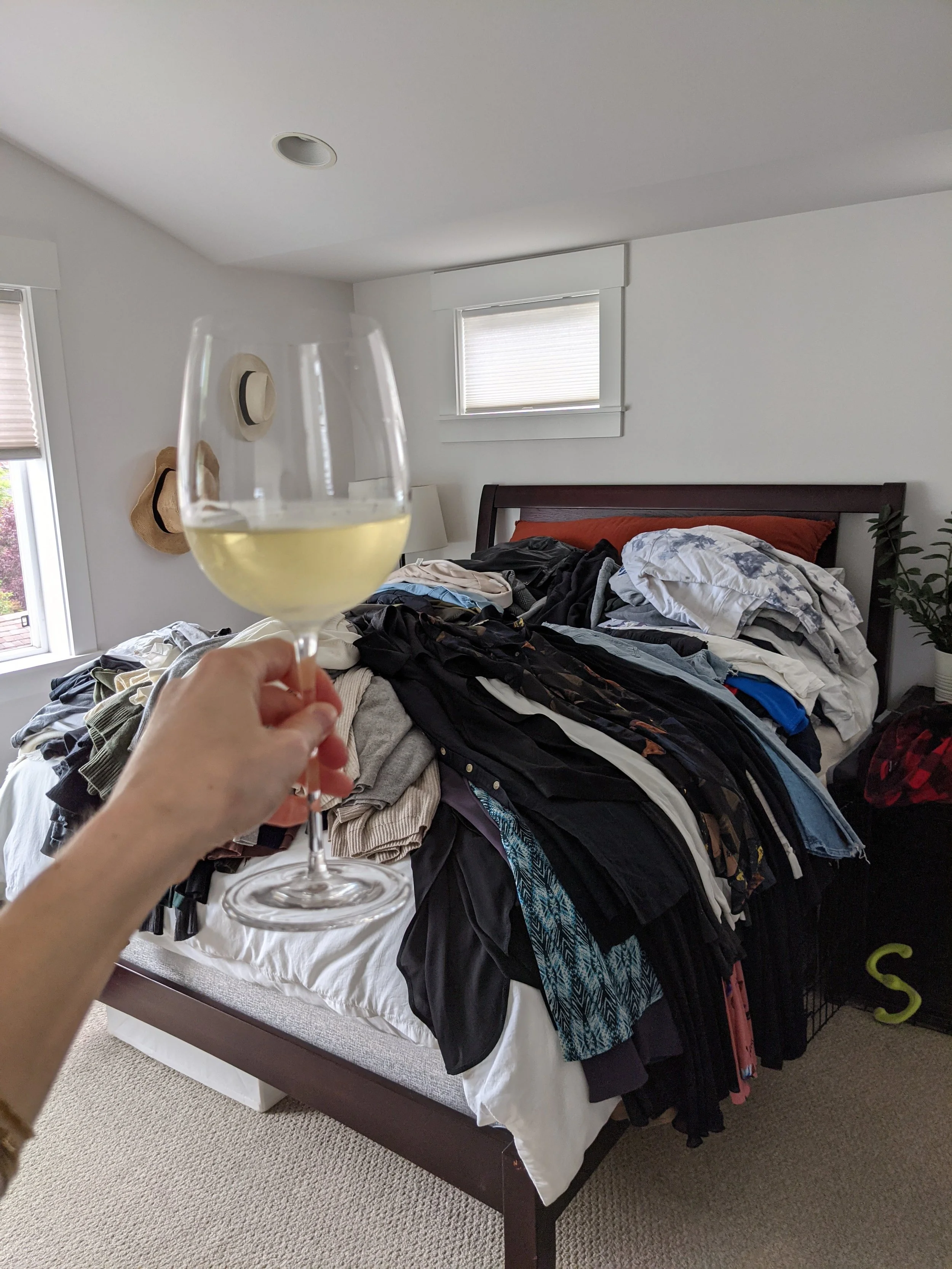
The BRAIN Framework, Applied to Your Home
BRAIN breaks one overwhelming question into five smaller, answerable ones:
B — Benefits. How would keeping (or getting) this actually help me right now?
R — Risks. What's the real downside if I let it go?
A — Alternatives. Is there another way to handle this — sell instead of donate, store it differently, keep one and release the rest?
I — Intuition. What does my gut say, separate from the "should" in my head?
N — Nothing. What actually happens if I don't decide today?
Five questions, instead of one impossible one. And it works because it isolates the specific thing that's actually keeping you stuck, rather than asking you to solve the whole decision in one leap.
Why "R" Does Most of the Work
Most people get stuck circling the alternatives in step A — turning over every possible option without landing anywhere. But the letter that tends to unlock the rest is R, risk. Once you name the risk out loud, instead of letting it sit as a vague, looming feeling, it almost always turns out to be smaller than the anxiety around it. And once the actual risk is clear, it becomes much easier to see which alternative is worth pursuing.
Take a sweater you're on the fence about. Named honestly, the risk of letting it go usually sounds something like: I might want a sweater like this again someday, and I'd have to buy a new one. That's it. That's the risk. It's rarely the catastrophe it feels like in the moment.
You're rarely choosing between "keep this and be prepared for anything that comes my way" and "part with this and be unable to handle what comes." You're choosing between "keep this" and "if I really miss it, I can probably find another one, and if I can't, I'll adapt." Even on the decisions you can't literally undo, the actual cost of getting it wrong is almost always smaller than it feels in the moment.
That's not encouragement to be careless with what you own. It's encouragement to let the low-stakes decisions actually feel low-stakes — instead of giving them the same weight as the ones where getting it wrong would really hurt.
The Takeaway
Most decluttering decisions are not permanent, and they're not really about the item. Next time you're standing in front of a drawer, a bin, or a closet shelf mid-freeze, try running the decision through BRAIN. Not as a rulebook — as five smaller questions instead of one impossible one.
Frequently Asked Questions
What is decision paralysis when decluttering? Decision paralysis happens when someone feels unable to make a choice about an item — whether to keep, sell, donate, or store it — because they're trying to find a single "correct" answer instead of a good-enough one. It often results in the item being set aside indefinitely, and can stall an entire organizing project.
How do I stop overthinking what to keep or get rid of? Breaking one large decision into smaller, specific questions helps. The BRAIN framework — Benefits, Risks, Alternatives, Intuition, and Nothing — is one way to do this. Naming the actual risk of letting something go, out loud or on paper, is usually the step that unlocks the rest of the decision.
Is it normal to feel anxious about decluttering decisions? Yes. Most people place more weight on everyday belongings than the actual stakes call for. Recognizing that most organizing decisions are reversible or low-cost to reverse — you can often replace or adapt — helps separate genuine high-stakes decisions from ones that only feel that way.
What is the BRAIN decision-making framework? BRAIN is a five-question framework — Benefits, Risks, Alternatives, Intuition, Nothing — originally used to support decision-making in medical and childbirth settings. It applies well to any moment of overwhelm where someone feels stuck between multiple options, including decluttering and organizing decisions.
Want to be the first to hear more tips like this?
Sign up for my newsletter where I share real-life organizing projects, gentle mindset shifts, and tools I swear by.
Based in Seattle and thinking about a room refresh of your own? I'd love to help. See how we can work together or get in touch here.
About Kari - Kari is a certified KonMari consultant and professional organizer based in Seattle, WA. Through Refine Organizing, she helps people create homes that feel lighter, calmer, and more aligned with how they actually live.
